Receive first-hand news on the latest bond issues, credit updates and special events when you join us on our Telegram channel at https://t.me/bondsupermart!
- Olam reported a -12.1% YoY decline in revenue but a 10.1% YoY growth in EBIT, driven by improved operating performance from Olam Agri and ofi. PATMI fell by -55.7% YoY due to higher interest expense and lower contribution from Olam Agri, following the 35.4% stake sale.
- We believe profit headwinds have started to ease in 2H23 and will continue to do so. Meanwhile, we see growth opportunities as Olam’s ongoing capital investment bears fruit. Together, we expect the Group’s earnings to recover gradually.
- Olam’s credit profile has moderated as compared to FY22 but remains healthy. Debt levels have risen but remain manageable. The Group also has ample liquidity and a further recovery in earnings in FY24 should also help to improve credit metrics.
- We like OLAMSP 4.000% 24Feb2026 Corp (SGD) and find it attractively priced. The bond is trading at an attractive yield of around 6.20% (full lot)/ 5.42% (odd lot) with slightly under two years left to maturity.
Olam Group Limited (“Olam”) is a leading food and agri-business company providing food, ingredients, feed, and fibre to over 22,000 customers globally. The Group has operations in farming, origination, processing, and distribution spanning over 60 countries. Olam reports revenue in three main operating groups as described below.
- Olam Agri is a food, feed, and fibre global agri-business focused on high-growth emerging markets. It primarily supplies grains and oilseeds, wheat milling and pasta, integrated feed and proteins, edible oils, rice. It also provides freight management and risk management solutions. Management remains committed to listing Olam Agri but has pushed back the potential IPO beyond H1 2024.
- Ofi, or Olam Food Ingredients, provides sustainable and natural ingredients for large, high-growth end-use categories. It is primarily involved in the cocoa, coffee, dairy, nuts, and spices businesses. Ofi operates its own farm, farm-gate origination, manufacturing facilities, and innovation centres. A proposed ofi IPO is expected to take place but is also delayed.
- The remaining Olam Group is responsible for incubating new sustainability and digital platforms for growth. This includes 1) incubating businesses like Nupo Ventures, 2) Olam Global Holdco, which houses the de-prioritised/exiting assets earmarked for exit, and 3) continuing/ gestating Businesses like Olam Palm Gabon, Packaged Foods, Arise P&L, Rusmolco, and Mindsprint.
Temasek Holdings is still the majority shareholder representing 51.5% of the total issued share capital of Olam. Other shareholders include Mitsubishi Corporation (14.5%) and Kewalram Singapore (6.9%) (as of end-2023).
FY2023 financial highlights
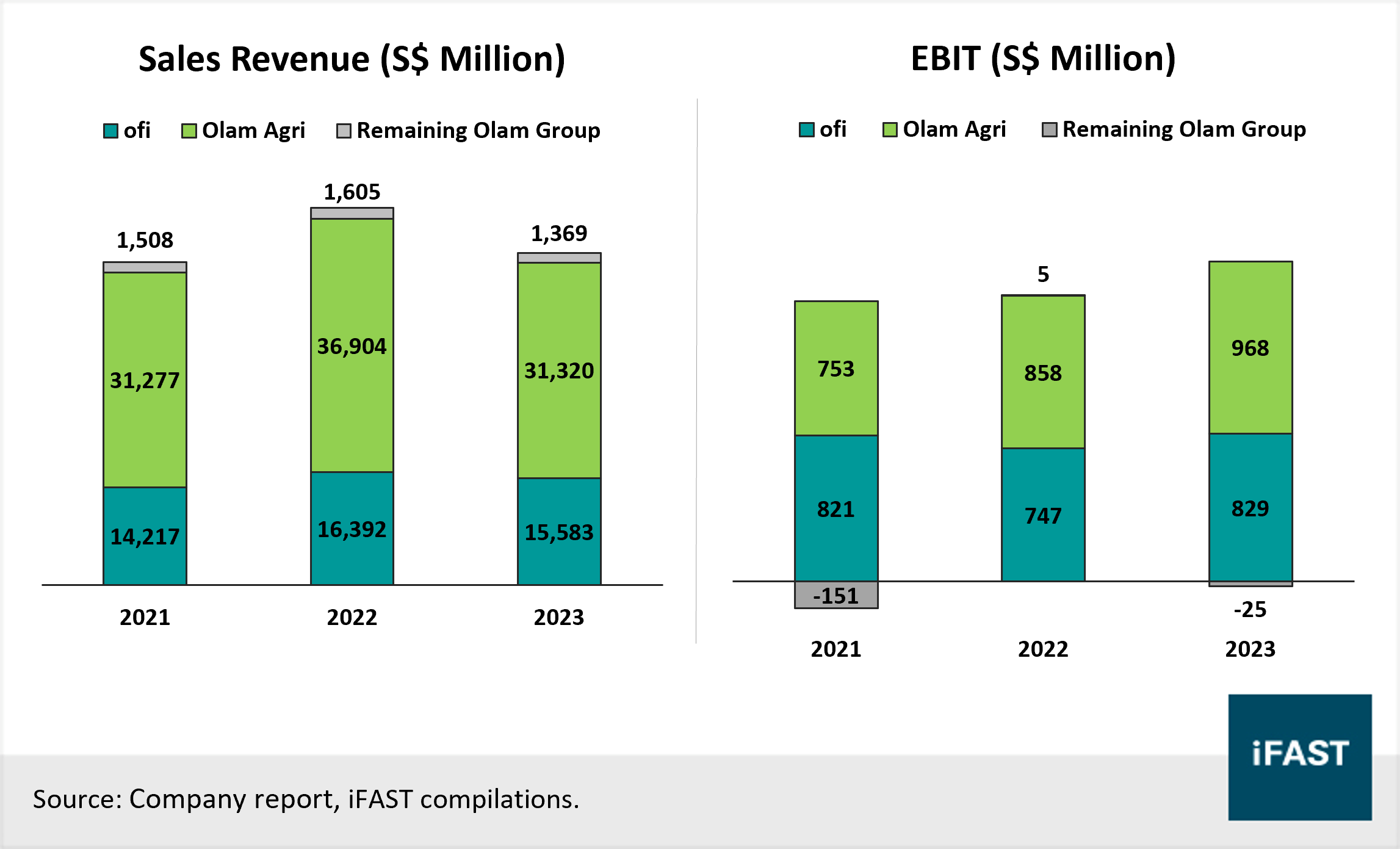
For the full year ended 31 December 2023 (“FY23”), Olam reported S$48.3B in group revenue, a -12.1% year-over-year (“YoY”) decline (chart 1). The fall in revenue was driven by the drop in commodity prices in 2023, from their highs in 2022, affecting key products like soy, corn, wheat, edible oils, cotton. That said, the Group managed to grow sales volume by 2.9% YoY to 44.1M metric tonnes, helped by a recovery in Olam Agri’s edible oils as well as grains and oilseeds volumes.
Olam’s operating performance has also improved in FY23. Earnings before interest and tax (“EBIT”) for the Group continue to grow, increasing by 10.1% YoY to S$1,771.9M in FY23(chart 1). This was driven by improved earnings from the major operating groups, Olam Agri and ofi. The former had contributed 54.6% of the Group’s EBIT, while the latter contributed 46.3%.
For FY23, Olam Agri recorded a 12.8% YoY EBIT growth due to strong contributions from the high-margin, Food & Feed - Processing and Value-Added segment, and a drop in the cost of sales as input prices fell. In the same period, ofi recorded a 11.1% YoY EBIT growth, driven by strong performance in its ingredients & solutions segment and its ability to pass through cost inflation. The remaining Olam Group incurred an EBIT loss of S$25.1M as compared to a gain of S$ 4.5M in 2022 dragged by lower earnings from the De-Prioritised/Exiting Assets and incubating businesses. On the other hand, continuing/gestating businesses recorded a moderate 1.1% growth in EBIT.
Chart 1: Revenue and EBIT contribution by operating segments
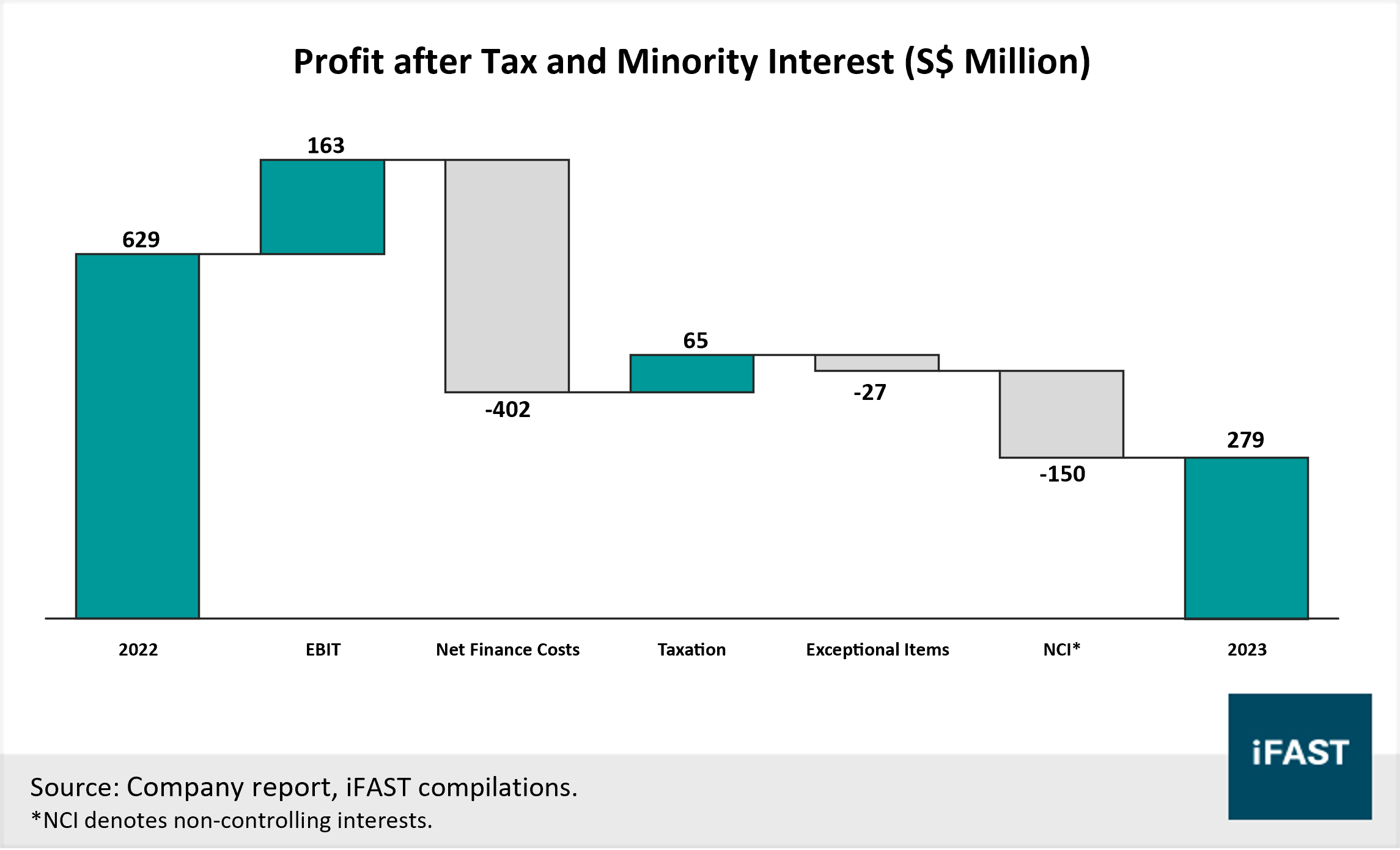
Olam’s profit after tax and minority interests (“PATMI”) fell by -55.7% YoY to S$278.7M (chart 2) while operational PATMI (excluding net exceptional loss from a one-off, non-recurring charge) fell by -41.3% YoY to S$458.1M. The group’s PATMI declined mainly due to greater interest expense as a result of the higher interest rates, lower share profit contribution from Olam Agri after the 35.4% stake sale to Saudi Agriculture and Livestock Investment Company (SALIC), and higher exceptional losses which included re-organisation costs.
Despite a drop in full-year PATMI, Olam’s 2H23 PATMI improved 15.5% YoY and 381.8% HoH to S$230.8 million due to improved EBIT growth and lower exceptional losses. We believe headwinds that troubled Olam in 2023 have started to ease in the second half and the improved earnings in 2H23 reinforce that. Moving forward, we continue to expect headwinds to fade as commodity prices have started to rebound, interest rates have likely peaked, destocking headwinds are dissipating, and consumer demand is recovering.
At the same time, we see growth opportunities from Olam as the ongoing capital investment bears fruit. On one hand, ofi remains committed to growing its strong, Ingredients & Solutions business, with investment in new facilities last year (New Zealand dairy processing facility, Brazil soluble coffee facility, Amsterdam Customer Solutions Centre). On the other hand, Olam Agri is also investing to grow its high-margin, Food & Feed - Processing & Value-Added segment (acquisition of the aquafeed business in Vietnam, soy crushing plant in Nigeria). Furthermore, we expect it to improve market presence in the large, high-growth Gulf region with its partnership with SALIC. Overall, with easing profit headwinds and growth opportunities, we expect Olam’s earnings outlook to recover gradually.
Chart 2: PATMI fell in FY23 largely due to higher net finance costs
Credit highlights
Debt levels have increased but capital profile remains decent. Total debt for Olam (including lease liabilities) rose slightly by 0.9% to S$ 16.3B in FY23, as compared to S$ 16.1B in FY22, due to higher short-term borrowings as the Group’s bank loans and overdrafts increased. That said, Olam’s total debt to total assets was estimated to be 0.49x in FY23, moderating from 0.51x in FY22 as total assets increased, in line with the 5-year average of 0.51x.
Debt ratios have deteriorated but are at a manageable level and normalising after a strong FY22. Olam’s debt over EBITDA, which was estimated to be 5.1x in FY23, rose slightly from the 4.9x in FY22, but remains lower than the past 5-year average of 5.8x. Treating the perpetual securities (“perps”) as debt, Olam’s adjusted debt over EBITDA was estimated to be 5.3x in FY23. Net gearing ratio rose to 1.73x in FY23 (1.97x after adjusting for perps) from 1.47x in FY22 as net debt increased while equity fell. That said, accounting for readily marketable inventories (“RMI”) and secured receivables, the net gearing ratio falls to a healthy 0.65x (RMI are liquid hedged/ forward contracted inventories that can be liquidated within 90 days without a reduction in sales price or margin).
The Group’s coverage ratios also fell as interest expenses rose after interest rates jumped in FY23. EBITDA to interest expenses ratio was estimated to be 1.9x in FY23, declining from 2.7x in FY22. Adjusted for distribution from perps, EBITDA to interest expenses ratio was 2.0x in FY23. With the bulk of rate hikes behind us and major central banks likely hitting peak policy rates, it is unlikely that benchmark rates rise further and as such, we think interest expense may face less upward pressure moving forward (if debt levels are maintained). We see room for coverage ratios to improve if Olam continues to record earnings growth.
Table 1: Debt metrics have worsened in FY23 but are normalising from a strong FY22
| Metrics |
FY19 |
FY20 |
FY21 |
FY22 |
FY23 |
5Y Average |
| Net Gearing
(X) |
1.4 |
1.7 |
1.7 |
1.5 |
1.7 |
1.6 |
| Adj. Net
Gearing (Incl. perps) (X) |
1.8 |
2.2 |
2.1 |
1.7 |
2.0 |
2.0 |
| Debt to EBITDA
(X) |
6.1 |
6.8 |
6.0 |
4.9 |
5.1 |
5.8 |
| Adj. Debt to
EBITDA (Incl. perps) (X) |
6.7 |
7.4 |
6.5 |
5.2 |
5.3 |
6.2 |
| Total Debt to
Total Assets (Ratio) |
0.49 |
0.53 |
0.52 |
0.51 |
0.49 |
0.51 |
| EBITDA
Coverage (X) |
2.5 |
3.1 |
3.9 |
2.7 | 1.9 | 2.8 |
| EBITDA
Coverage (incl. perps dist.) (X) |
2.7 |
3.5 |
4.4 |
2.9 | 2.0 |
3.1 |
| Source: Company
report, iFAST compilations. |
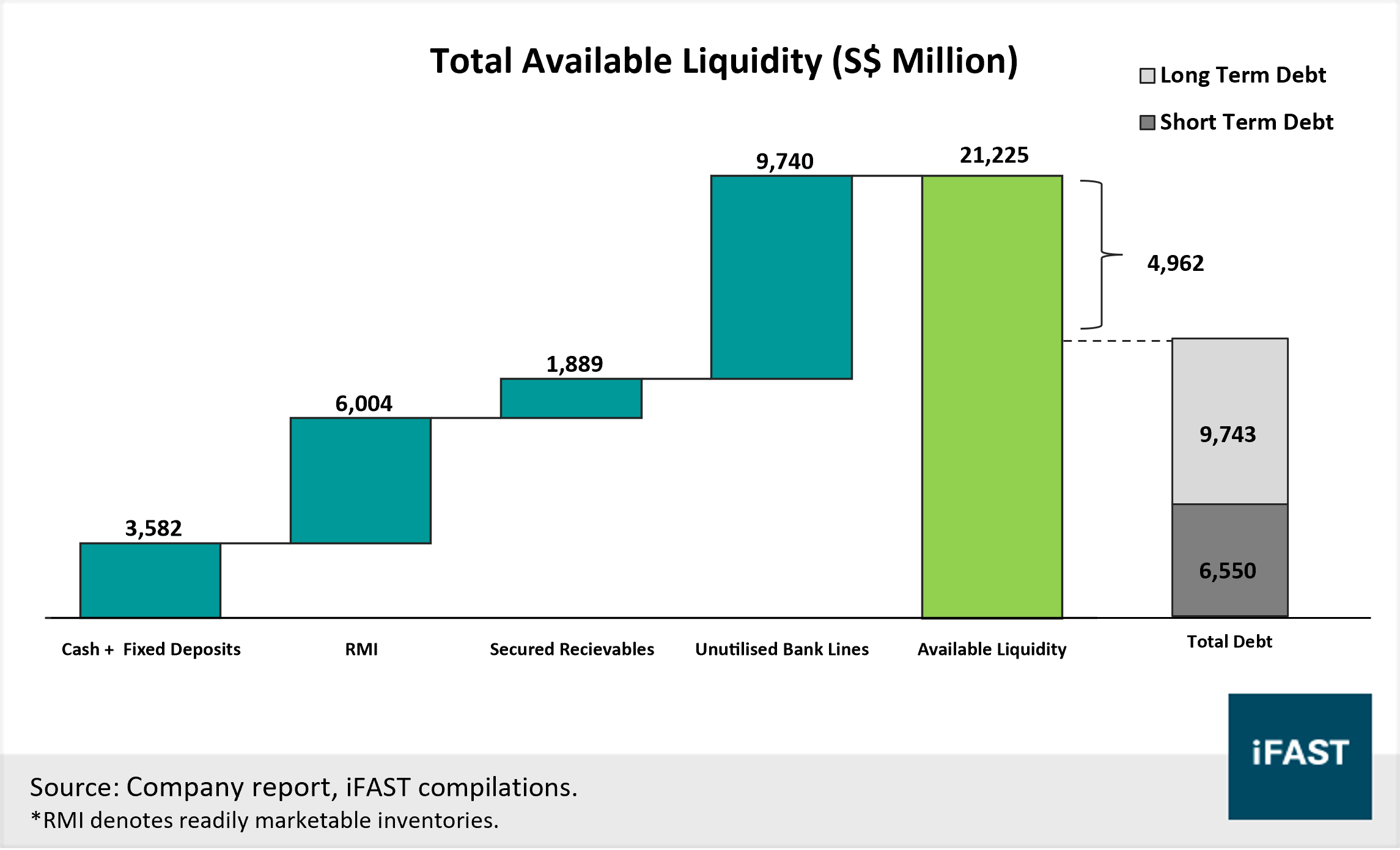
Sufficient liquidity to cover debt and operational requirements. As of 31 December 2023, Olam’s cash position has decreased by S$1,223.9M to S$ 3,581.6M as the Group repaid external loans. Cash balance may be less than the S$ 6,550.4M of short-term debt but including S$6,044M of readily marketable inventories, S$1,889M of secured receivables, and S$ 9,740M of unutilised bank lines, the Group has a total available liquidity of S$ 21,255M. This is more than sufficient to cover total debt (including lease liabilities) of S$ 16,293M in FY23, leaving a healthy S$4,962M of liquidity headroom for the Group.
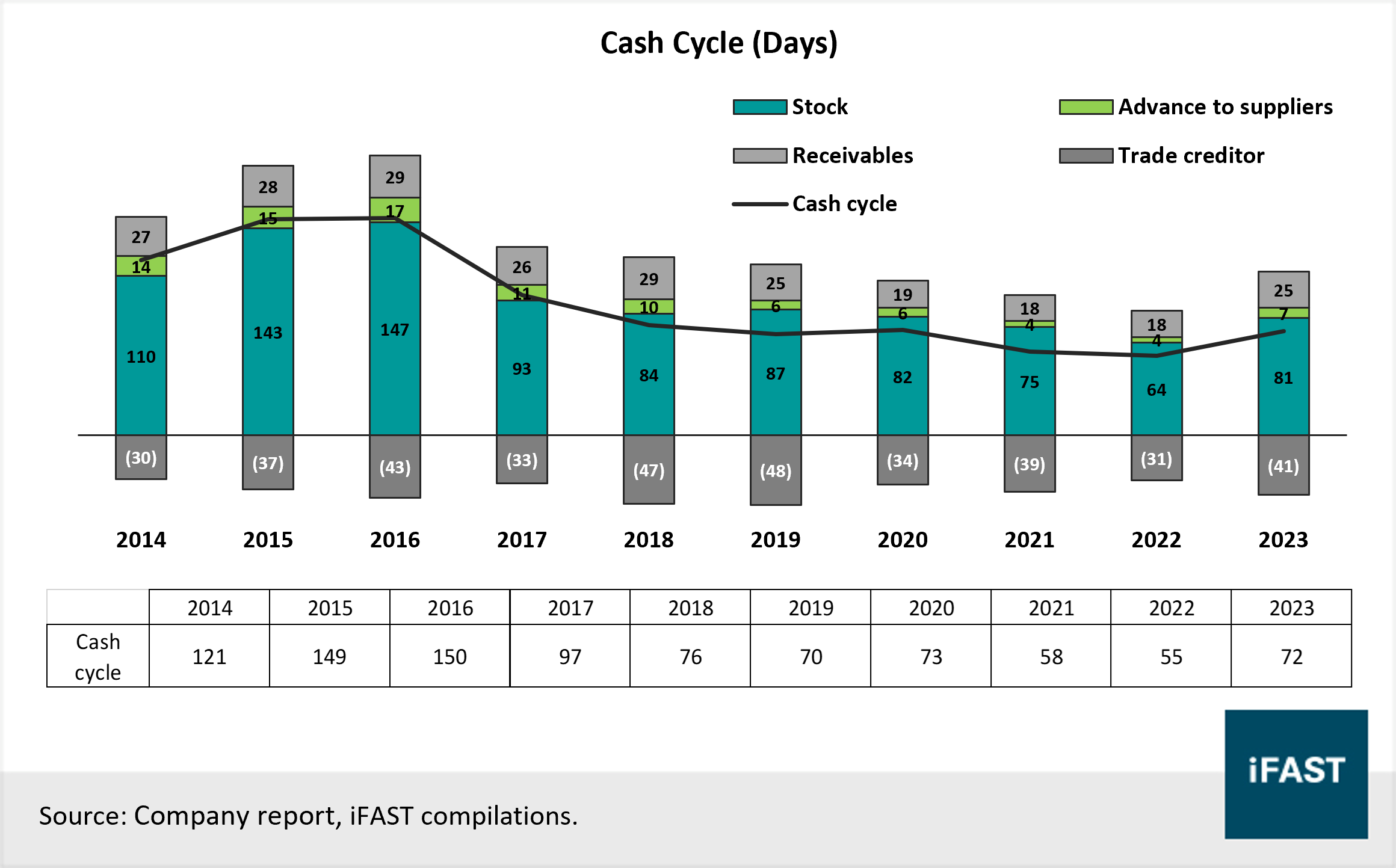
Cash flow has moderated but cash cycle remains healthy. Net operating cash flow was lower at S$ 1,030.9M in FY23, as compared to S$ 1,928.1M in FY22, due to higher working capital requirements. As such, free cash flow to firm also fell to S$ 215.4M in FY23 from S$ 2,698.9M. Despite so, Olam’s ability to convert working capital to cash remains strong and has improved significantly over the years. The cash cycle (“CC”) remains low relative to history at 72 days in FY23, despite extending over the past year. This is important as agriculture businesses tend to face risks linked to biological and weather-related factors, rural area infrastructure, and government trade policies. This often may influence the CC which can delay a company’s cashflow.
Chart 3: Sufficient total liquidity to cover total debt
Chart 4: Cash cycle has risen slightly but remains low relative to history
Recommendations
Table 1: Olam’s fixed rate and perpetual bonds
|
Bond Name
|
Issuer
|
Maturity Date / Call Date
|
Bond Price
|
Years to Maturity / Call date
|
Yield to Maturity / Next Call
(%)
|
OLGPSP 5.375% Perpetual Corp (SGD)
|
Olam Group Limited
|
18 July 2026
|
93.75
|
- / 2.23
|
- / 8.50
|
OLAMSP 4.000% 24Feb2026 Corp (SGD)
|
Olam International Limited
|
24 Feb 2026
|
96.25
|
1.83 / -
|
6.20 / -
|
|
Source: Bloomberg Finance L.P., Bondsupermart, iFAST
compilations. Data as of 23 April 2024
|
In our view, Olam’s credit profile has moderated as compared to last year but remains healthy. Debt levels have risen but the degree of leverage and debt ratios remains manageable. The Group also has ample liquidity and a further recovery in earnings in FY24 should also help to improve the Group’s credit metrics.
Back in early September 2023, several Nigerian news outlets reported that Olam Nigeria and Olam International were investigated for their alleged involvement in a foreign exchange fraud. In February 2004, Olam announced that an internal review was conducted and no evidence regarding the fraud was found. The Group has also fully cooperated with authorities with no charges brought by them against its unit or any of its officers. Following this, Olam also stated that it will continue to operate in Nigeria normally.
We see this announcement as good news for bondholders and a potential close to the allegations, with no material impact on the Group’s credit profile (read - Olam Group update –
Olam Group update – No evidence of involvement in multi-billion dollar fraud allegations)
Between both of Olam’s bonds, we like OLAMSP 4.000% 24Feb2026 Corp (SGD). We find the bond attractively priced at an indicative ask yield to maturity of 6.20% (full lot) and 5.42% (odd lot on BE). There are no close comparable peers within the SGD bond market but Olam’s 2026 bond is also one of the highest yielding within the SGD space with a remaining tenor of around two years. With strong liquidity and improving earnings, we expect the Group to face no issues redeeming its fixed rate bond coming due 2026. Lastly, after the potential IPO and demerger of ofi, Olam International Limited (bond issuer) will likely remain a subsidiary of ofi and the principal debtor of 2026 bond.
The perp
OLGPSP 5.375% Perpetual Corp (SGD) offers a relatively higher yield compared to other SGD perps. However, unlike the fixed rate bond, the perp carries higher risks after the potential IPO and demerger of Olam Agri/ ofi. With Olam Group, the holding company and issuer of the bond, as the remaining entity after the two IPOs and demerger, we expect the former to see a substantial loss in earnings and cash flow as both Olam Agri and ofi are major revenue contributors.
Investors should also note that Temasek Holdings is a major shareholder for the Group at the moment. However, with a potential IPO of Olam Agri and ofi we also do not rule out the possibility for Temasek to maintain or pare down their stakes in Olam Group.
Declaration: For specific disclosure, at the time of publication of this report, IFPL (via its connected and associated entities) holds a position in OLAMSP 4.000% 24Feb2026 Corp (SGD) and OLGPSP 5.375% Perpetual Corp (SGD) and the analyst who produced this report holds a NIL position in the abovementioned securities.
Our podcast series, Yield Hunters, is available on Spotify, iTunes Podcasts and Google Podcasts. We share our thoughts on new bond issues and hold discussions on the fixed income space. Listen to our latest episode below and follow us!